Preserving Research Materials from Grandma’s Attic
Preserving Research Materials from Grandma’s Attic
In our digital age of record keeping, photography, e-books, AI, and privacy controls, what will access to firsthand accounts of history look like for the next generation of historical fiction writers? With most of the Greatest Generation gone, the “Depression babies,” who seemingly saved everything, are Boomers’ attics, basements, and storage units filled to the same extent with personal histories stored in diaries, letters, bank statements, postcards, and photographs?
Preserving Research Materials from Grandma’s Attic
Twenty-four years ago, as the youngest child of parents from the Greatest Generation, I undertook the dreaded task of emptying the house my parents had lived in for fifty-four years. While one of my brothers helped with the larger pieces of furniture, I volunteered for everything else, for I knew he wouldn’t have the patience to spend days in the attic and basement, poring through every box, bag, and piece of old luggage in closets. He would have scooped everything into armfuls and tossed them straight into the Dumpster in the driveway.
I’m glad I volunteered. Otherwise, we might never have found my mother’s sterling silver flatware buried beneath Halloween costumes (i.e., Casper the Friendly Ghost, complete with an unbreathable, sweat-drenching plastic mask, circa 1966) in a moving box.
And what about the mouse-nibbled box my dad’s shirts came in from the cleaners? Would my brother have paused to open the lid and look beyond the silverfish scurrying out? Would he have lifted the top envelope and discovered twenty more beneath it, all postmarked 1943–1945? Letters my father, Ensign Eliot H. Robinson, US Navy, had written from his ship in the South Pacific. Letters none of us had ever seen before.
On a September day in 2001, I picked up each letter, sat on the attic floor, beneath a single light bulb, and read every one of them. Even the letter describing attacks by suicide swimmers. I was reading it two weeks after suicide pilots attacked the World Trade Center and Pentagon. History does repeat itself.
After carefully packing the letters away into a clean box, along with a few other treasures I found (not the Casper costume), I headed home thinking, I will not subject my sons to this same task. I wouldn’t leave them to sift through possessions, deciding what held value to save, or what belonged in the Dumpster. Because what would my sons find interesting? Given their, and their wives’, lack of interest in my china and crystal, I expected a hard no on saving their grandmother’s 1930s dance cards from various Massachusetts colleges.
But what about a writer crafting a story set in the 1930s, one who wants her character to find romance at a college dance? Where would that writer learn dance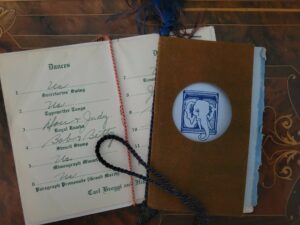 cards were part of those rituals? That a small, folded piece of cardboard bore the college seal on the front, with a school-colored tassel dangling from a notch at the top? That a gentleman needed precise, tiny handwriting to fill his name? Wouldn’t those details enrich a scene in which a woman hands her card to the gentleman before her, feels a tingle as their fingers touch, and anticipates what it might feel like to have his hands on her waist?
These tiny artifacts of the past are most likely still sitting in attics and basements everywhere. The responsibility for finding and preserving them, however, falls to those who appreciate their value. Today’s historical fiction authors must become the keepers of lost things, the shepherds of research material who are willing to share their discoveries for the greater good. Perhaps one writer won’t need a dance card detail but another will.
Your mission, should you choose to accept it: Hunt. Discover. Document. Save. Volunteer to clean out a family home. Visit estate sales. Pore through milk crates at flea markets. Once you’ve filled your trunk with treasure you deem valuable, then what? Will your partner eagerly help you unload them in your attic? Maybe. Maybe not. And then what? How will the writer crafting that college dance scene know you have 1930s dance cards available for reference?
Could we, as historical fiction authors, create a traveling repository of firsthand materials supported by a digital database that tracks where each item resides? Or perhaps a shared social media account with easily accessible photos? It would be a monumental undertaking, but if we started small, each of us offering up just one item, could it work? A traveling archive that gives life to the past for our present and future.
I have some dance cards I can share. Contact me if you’d like me to send them on to you.
Originally posted to Historical Novel Society, North America, 08.17.26.(opens in new tab)
